HTTP cycle
Helpful resources for understanding the Web Architecture.
The HTTP cycle is the process by which a client (such as a web browser) communicates with a server to retrieve or submit data. The server processes the request and returns an HTTP response.
- Topic
- Web Architecture
- Estimated Reading Time
- 5 minutes
- Last Updated
- September 2026
Overview
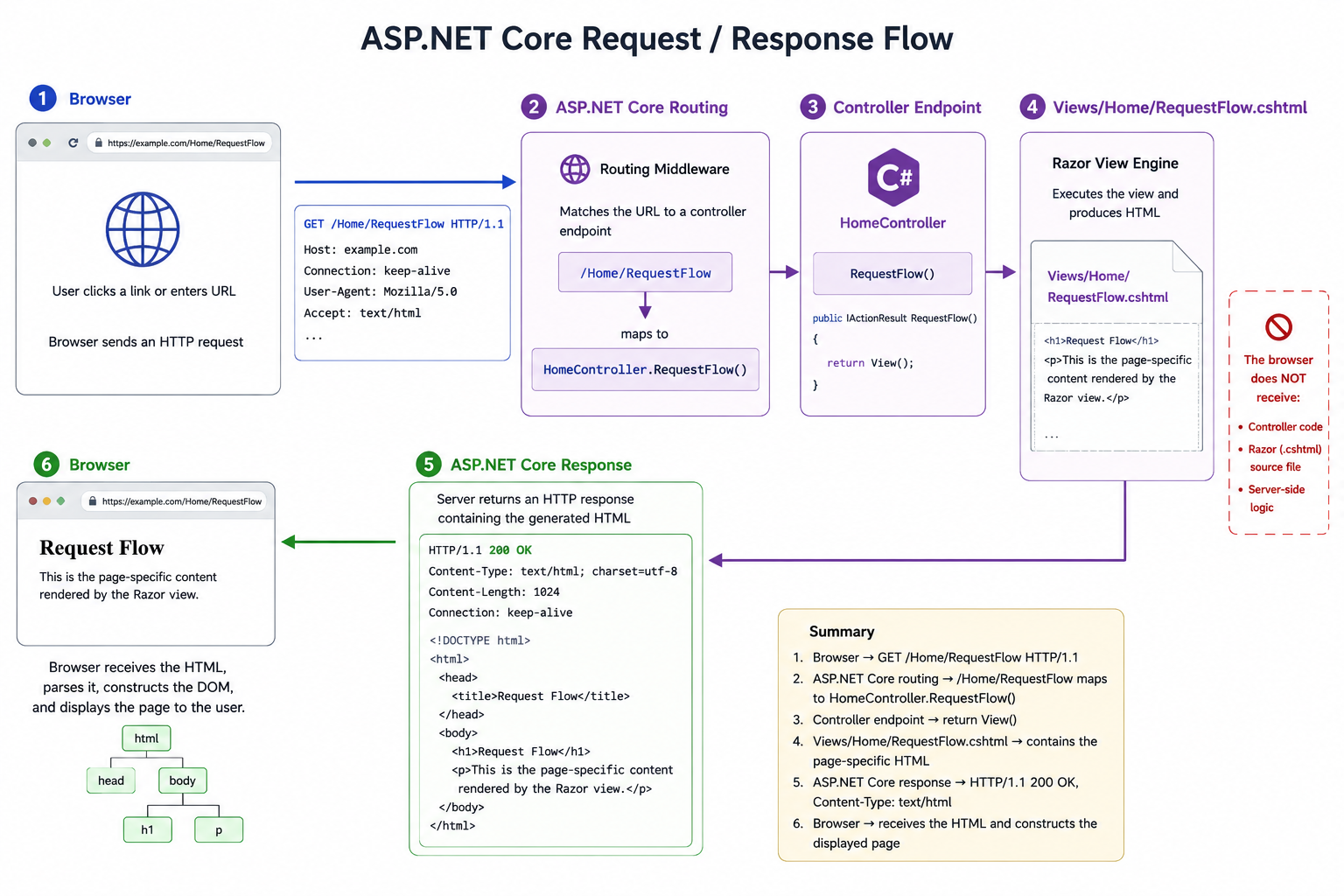
The Http cycle is shown in the image below. We outline how it starts with a GET request from a client, usually a browser in our case. The request is then processed by the server, which returns an HTTP response to the browser. The response will be a status code indicating the outcome of the request. Also our simple application will send the HTML requested by the browser.
The Browser Sends an HTTP Request
When the user visits a URL, the browser creates an HTTP request containing information such as the request method, requested path, HTTP version, host name, accepted content types, browser information, cookies, and other request headers.
GET /Home/RequestFlow HTTP/1.1ASP.NET Core Selects an Endpoint
When the request reaches the ASP.NET Core system, it is processed through the middleware pipeline, and the routing system examines the URL and HTTP method to find a matching endpoint. It then directs the request to the appropriate controller action.
/Home/RequestFlow → HomeController.RequestFlow()The Controller Returns a View
The selected controller action computes any necessary data (in our simple cases—none) and then returns a ViewResult, which tells ASP.NET Core to locate and render the corresponding Razor view.
public IActionResult RequestFlow()
        {
            return View();
        }
The Server Returns HTML
The View code does any additional computations or HTML creation (in our simple case—none) and produces the final HTML document, which the server sends back to the browser as an HTTP response.
HTTP/1.1 200 OK Content-Type: text/htmlThe browser reads the response and renders the HTML as a visible web page.